Roswell Road Talk Debut Album, Their Voices And More
Words by Glenn Sargeant
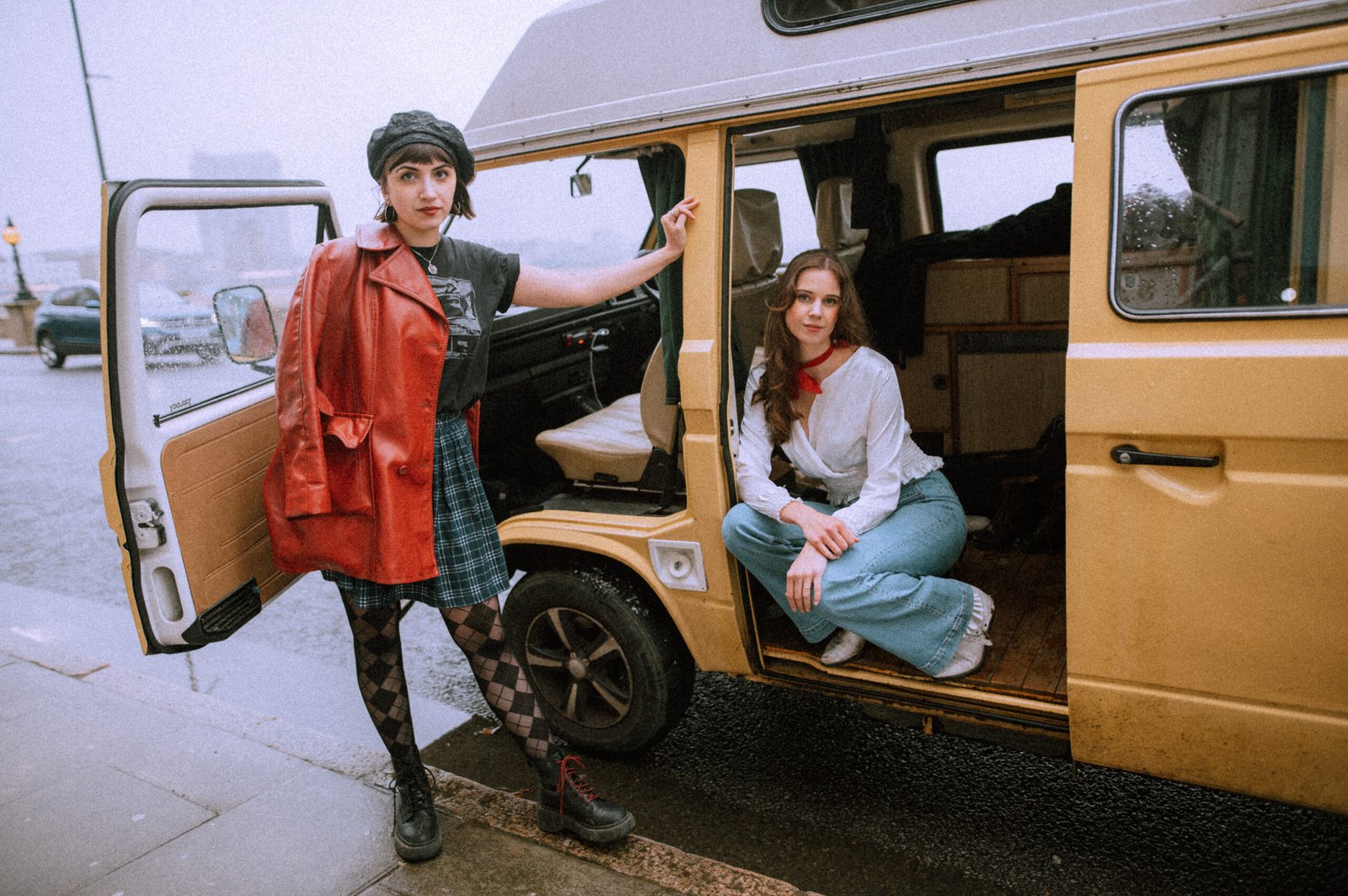
Feature Image Photo Credit: Sophie Barloc
Indie-Americana duo Roswell Road have released their debut album ‘Rebel Joy’. They kindly chatted to JLTT all about it:
Who is in Roswell Road, how did you meet and what do you play?
Jazz said: We’re Jasmine Watkiss and Zoë Wren, and together we are Roswell Road, a harmony-obsessed Indie Americana duo based in London, UK. We met way back in 2017, on a sunny winter morning in Ely Market Square in Cambridgeshire. I had bumped into my friend Dave who invited me to join him and some friends for coffee. One of those friends was Zoë; she was there with her guitar and we got chatting about music. I had just left a band and Zoë had been solo for a while and wanted to play with other musicians, so our meeting was perfect timing and we decided then and there to do an open mic together a month later at Julia’s Tearooms in Ely. Our musical chemistry was weirdly instantaneous, so after that open mic, we booked our first show as a duo in March 2018. We both take turns on lead vocals, and acrobatic vocal harmonies are a core part of our sound; we like to swap lines and weave around and over each other vocally. To accompany our singing, I play violin and ukulele while Zoë plays guitar and stomp box. She is also a great pianist, but this rarely makes it into our live Roswell Road set.
What is your earliest musical memory?
Jazz: I remember sitting at my parents’ piano at about the age of three ‘composing’ songs. My parents, who are both music teachers, were of course delighted by this; my dad would write up my ‘compositions’ on his boxy 90s Apple computer. I also have a vivid early memory of my parents singing ‘Happy Birthday’ in harmony. I think hearing them sing in this way is what rooted my early love of and fluidity with harmony.
Zoë: Neither of my parents are musicians, but my dad has a lovely voice and would always sing with me around the house. They got me this tiny toy keyboard at the age of three or four, and I would spend hours plinking away at it with no clue what I was doing, until eventually they figured they had better get me piano lessons!
When did you begin songwriting?
Jazz: If you discount my childhood compositions and GCSE and A Level music coursework, I wrote my first song when I was 18 – a good while before Roswell Road was formed. I wrote very sporadically and occasionally, as until Roswell Road began, I had been in other people’s bands playing their songs – which I loved! But I feel most proud to be performing my and Zoë’s own songs now.
Zoë: I thought that I started writing songs in my mid teens, but recently I’ve been digitising some of my parents’ old camcorder footage and I found a video of me aged around eight years old singing a song I’d written, which I announced proudly to the camera. It’s not going to make it onto any albums, but I guess I started earlier than I even remember!
You have your debut album ‘‘Rebel Joy’ out now. How did you want to approach the making of the album?
Jazz said: In complete honesty, I don’t think we thought about the approach as much as we will for our next record, which we’re already starting to think about. We are so proud of this album but it has been a steep learning curve for us both. There wasn’t a lot of strategic thought initially beyond ‘Hey, let’s make our first album!’ We knew we wanted to do it, but I don’t think we knew how to make it sustainably, so that we weren’t both exhausted and stressed at the end. The record took us four to five years from start to finish as we were fitting it in around the pandemic, living in different countries for a while, my full time job and Zoë’s streaming career on Twitch. There have been huge life changes for us both during this period – we both moved several times, we both got married, Zoë moved to Switzerland and back again. We’ve come out the other end of this album a lot savvier about how to make one in the future. ‘Rebel Joy’ has been a long time coming, an elephantine gestation process! But we are incredibly proud of this record and have worked our butts off to make it the best we could at this moment in our lives.
Where did you record the album and who produced it?
We recorded the album in multiple locations: Initially, we recorded the earliest tracks on the album in Zoë’s home studio in Switzerland, and then at her home studio in London when she moved back to the UK. We also borrowed RYP Recordings in North-West London for a day in July 2025 to put the finishing touches on our final songs. And of course, Dave and Joe Dunwell recorded their parts at their Mill Lane studio in Leeds.
The Dunwells produced the album and brought totally new angles and creativity to all the songs – four heads are better than two, as it happens – and best of all they are sunshine in human form. They’re based up in Leeds and we’re down in London, so we’d communicate about production by WhatsApp voice notes and video. One of my favourite videos they sent us was of them kicking around their studio singing our song ‘Bolder’ like pirates, see-sawing the phone to mimic being on a boat. Pure joy. We wrote two of the songs on the album with them, ‘Holy Mountain’ and ‘Let Myself Be Still’. We were initially a little nervous about how four people could write one song, as we’d never group-written before ‘Holy Mountain’ came into being, but it was a seamless experience. They were so positive, so excited, so encouraging; it felt like we were carving one big chunk of stone into a beautiful sculpture, each tackling a different side of the block until we made something complete.
Zoë’s husband Tristano Galimberti mixed and mastered the album – he did a brilliant job, all while launching his own business, and we are grateful to him for all his hard work, dedication and love.
Do you have any interesting, funny or memorable stories from the recording sessions?
Jazz says: Zoë has a cow-shaped cushion in her home studio, affectionately named ‘Marshall’. Every time I’d go record at hers, I’d always subconsciously pick up Marshall to absentmindedly cuddle him while doing vocal takes or discussing mixes. Apart from cow-shaped cushions, it was just nice going over to Zoe and Tris’s a lot to work together at their home. I think we make a good team and I’ve got lots of fond memories of us getting really engrossed talking about the intricacies of mixing and mastering, or just taking a break together to share a meal. And even our frantic excursions to the post office with piles of boxes of pre-orders in the two weeks before the album was released are kind of hilarious to look back on too. There will be a special kind of nostalgia to being surrounded by head-height cardboard boxes in Zoë’s living room while we beavered away in the lead-up to release day.
Did you use any particular instruments, microphones, recording equipment to help you get a particular sound/tone for the record?
Zoë says: Most of the vocals were recorded in my home studio on an SM7B (the direct descendent of the SM7 used for albums by Michael Jackson, Bob Dyan, Sheryl Crow and many others) which has a great natural, warm tone. A few songs were also recorded at RYP Studio in North London on a Peluso C12 and the vocals and instruments were run through Warm Audio 273 preamps. We played the same instruments we play on stage (Jazz on her violin and Kala 8-string tenor ukulele, and me on my Martin OMC-15ME guitar). In terms of plugins, Fabfilter was the bread and butter for EQing, compression and reverb. Tris also used Kush Audio’s Omega preamps on acoustic material, and their Clariphonic parallel EQ when a more ‘silky’ or ‘sparkly’ mid-high end was needed. Their Goldplate reverb, which was modelled off a $10,000 plate reverb unit(!) was used for the main vocals in most of the songs in the album.
Which of your new album tracks hear you at your a) happiest, b) angriest and c) most reflective?
This record phases between things that matter to us internally and things that matter to us externally – and they are linked inextricably. We’ve got a song about feeling self-conscious at parties; we’ve got a song about Zoë’s parents’ wayward youth spent backpacking around the world; we’ve got a song about climate activism and one about burning out and needing rest. Our inner feelings are shaped by what is going on in the world, and our songs sit along that spectrum. The word ‘reflective’ describes all ten songs on the record.
Jazz says: All ten songs are underpinned by a complex web of contrasting emotions, so it’s difficult to define them by singular feelings. I’d say that the last song we wrote for the album, ‘Island Citizen’, is our angriest. We like to joke that we were ‘angry’ the day we wrote Can’t Take My Soul – which we affectionately refer to as our ‘Folk the Patriarchy’ song – but I think ‘defiant’ is a better description for how we felt when writing it. ‘Holy Mountain’ is full of hope, wonder and nostalgia, while Arabella is about love, worry and acceptance. But I think I feel happiest when performing ‘Weirdo at the Party’ – it’s a song about being my honest, awkward, socially clumsy self and voicing the insecurities I’d normally keep silent. There was something joyfully freeing about writing it.
Zoë says: I completely agree with what Jazz has written above. I’d also add that probably the most reflective song for me is Let Myself Be Still. Lyrically it is quite simple and honest, about the realities of feeling exhausted while on tour at the end of a long year and needing to rest, while simultaneously feeling so grateful for what we get to do, and for our friendship. Musician life is full of such extreme ups and downs and sometimes it can be hard to process all the conflicting but co-existing emotions that come along with it.
Was it a difficult album to write?
Jazz says: In some ways, yes, mainly because we didn’t have a lot of time to write around my then-full-time job and our touring schedule. Writing can feel hard when you don’t have much free time to do it. But often, difficult things are very much worth the struggle. I think both Zoë and I are prone to overthinking and second-guessing ourselves and our creative outputs. There is a fine line between a constructively critical voice in your head and an outright negative one, which can be a barrier to a happy and balanced creative process. We actually took a lot of positive learnings away from our songwriting sessions with the Dunwells, who are much more carefree in their songwriting process than we have been in the past.
Their positive and constructive ‘feel your way through a song’ approach was a gift. I think the easiest song we wrote as a duo, in terms of how quickly we did it and how satisfied we were with the end result, was Island Citizen, as we’d taken a lot of positivity from our previous songwriting sessions with the Dunwells, which produced Holy Mountain and Let Myself Be Still respectively. Although we may have struggled at times, I think we both agree that the songs on ‘Rebel Joy’ are our best so far; we have both evolved and grown as songwriters as a result of the work we put into this record, as well as the influence of great songwriters like Joe and Dave.
Who designed the album artwork?
All the photos that make up the album artwork are taken by incredible photographer Sophie Barloc. We absolutely loved working with her and so many stunning photos came out of that shoot because she’s got such a good eye and made us feel both at ease and powerful. We should also give a shoutout to Scarlett Woolfe, stylist on that shoot and fellow musician, as the wardrobe really went above and beyond what we would have picked out for ourselves. Our wonderful friend Ioana Brain, who is incidentally a talented songwriter, did the graphic design for the album and we can’t thank her enough. And the brilliant Selkies, aka Louise Ní Chuilinn, illustrated our beautiful new logo which has made its way into the album’s visual identity too.
One of the tracks is the single ‘Weirdo At The Party’ which is out now. What was the story/inspiration behind the track?
Jazz says: The more time I spend on the planet, the more I’m comfortable being honest about myself in my songs. I’ve never felt like I truly fit in anywhere and this has been a deep-seated and unspoken feeling that I’ve carried with me for most of my life. But it is also very authentic to who I am. I reached a point in my late twenties where I decided I wanted to be more myself in my songwriting, so at some point I decided to start saying the quiet parts out loud. I’ve often felt out of place in big groups of people. ‘Weirdo at the Party’ is inspired by a party I went to where I felt uncomfortable in my own skin all evening. I kept second-guessing myself and I felt like I didn’t know how to talk to anyone all night. I left early and started writing this song the next day. It became a way for me to pick apart and have fun with a moment of discomfort. But it also calls out how trying to be cool can often have exclusionary results. It’s a silly, cut-loose kind of bop, but meaningful and resonant to me too.
The single is accompanied by an official music video. What was the thought process behind the video and who directed it?
Jazz says: ‘Weirdo at the Party’ has a straightforward narrative weaving through it, about a bad party and social anxiety, and we extended that narrative into the music video we made with the wonderful James Westlake and Julian Hundy. The video features two parties attended by the same cast of people. One is set in a grey and dour windowless office while the other a zany, colourful cabaret full of whimsical props – to juxtapose a feeling of conformity and judgement with a feeling of freedom of expression and energy. We wanted the music video to feel fun, silly and profound all in one go. We co-directed it with James and had a blast.
Zoë says: There’s a message in the video that we should all feel liberated to embrace our individual weirdness and quirkiness, and we had a ridiculous amount of fun scouring the local charity shops for outlandish outfits and bringing out our weirdest dance moves for the shoot. It’s an incredibly freeing feeling to commit 100% to dancing in the most uninhibited way you can, and I highly recommend it to everyone! Perhaps even at your next office party…!
Where is your hometown and could you please describe it in five words?
Jazz says: Bournemouth, Dorset: Eccentric, hippy, ramshackle, stoner, laid-back.
Zoë says: London. Vibrant, chaotic, full of opportunity.
How do you look after your voices?
Jazz says: I’ve been having singing lessons on and off since 2023, and it has hugely helped my technique. My singing teacher Susan is fantastic; she teaches a scientific method called ‘Estill’ which pays close attention to the physiology of the voice. I’m now more aware about things like larynx position and vocal folds, as well as my breath control. I try not to drink too much caffeine on singing days and stay as hydrated as I can. I try to physically warm up (although I could do more, admittedly) and meditate when I have time, as I think so much of your voice and ability to use it well under the pressure of performing live is bound up in your headspace.
Zoë says: The most important things for me are warm ups, hydration and knowing my vocal limits. I’ve learned not to push myself – whether trying to force volume when I perform or even just shouting a conversation in over loud music in a crowded pub. Maintaining my vocal health is incredibly important (both for me personally, and how I earn a living), and sometimes I’ll need to set a boundary because I know from experience how overuse can affect my voice.
Do you have any live dates planned in the UK/Europe in 2026?
Yes! We are touring ‘Rebel Joy’ from March – May in the UK, and then we head to Germany for a few dates on 15 May – to be announced soon! Find out more at www.roswellroadmusic.com/show-dates and sign up to our newsletter for new show announcements at www.roswellroadmusic.com/newsletter.
What two things do you hope to have achieved once you have left the stage?
We hope to have connected with the audience on some level, whether they personally resonated with some of our lyrics or just really vibed with the tunes. And perhaps most importantly, we hope to have had fun and put on a performance we’re proud of – we do what we do for the joy of it and we always hope that that comes through.
Do you have any favoured stage instruments, effects, pedals, microphones etc?
Jazz says: Until this year, my gear has been non-existent! But we just invested in a Strymon Timeline pedal that I can run both my violin and ukulele through to create some interesting sound effects. I’m really excited to properly learn how to use it. As for my instruments, my violin is an antique passed down to me by my aunt, and my ukulele is the gorgeous 8-string Kala Ka-8E Tenor Ukulele, which I adore. Having eight strings instead of four gives it this glorious resonance that my (admittedly still very good) Pono 4-string tenor ukulele doesn’t quite have.
Zoë says: I love the combination of my Boss OC-3 Super Octaver and my Roland SPD::ONE KICK to give our live shows a fuller sound with bass and a kick drum stomp. I also recently bought a Neural DSP Nano Cortex, which gives me a consistent mic’d-up studio sound on stage, replicated from a GIbson Hummingbird using neural capture technology, then polished with a chain of EQ and spatial effects. I bought it off John Smith, shortly after seeing him perform using one at Folk Alliance in New Orleans this year! I’m usually gigging with a Martin OMC-15ME or an Ibanez AE315FMH guitar – I alternate between them depending on what I’m feeling!
You are given the opportunity to write the score for a film adaptation of a novel that you enjoy. Which novel is it and why?
Jazz says: I’ve read lots of wonderful books in recent years, but one that I think would be glorious to write a soundtrack for would be Circe by Madeline Miller. It’s visually very rich and fantastical, and does a great job of blending ancient stories with modern perspectives. Because of that, I think it would be such fun to create a soundtrack for it that mirrors and amplifies these elements. I’ve got hugely into video game soundtracks in recent years – if I’d known that it was a job I could have when I was a kid, I think I would have pursued a career as a soundtrack composer.
Zoë says: One of my favourite fictional worlds of the last few years is that of Piranesi by Susanna Clarke (a novel given to me by Jazz in fact!). The mysterious, labyrinthine house inhabited by the main character is so vividly described, and the themes of identity and memory so wrapped in intrigue that I can imagine an atmospheric, motif-based, almost hypnotic score to underpin it all, that would be a lot of fun to work on! During my music livestreams I sometimes create improvised live loops to prompts and I can imagine composing something based off a looped structure for an adaptation of this novel.
Who are some of your musical influences? Do you have any recommendations?
Jazz: Yola, Aldous Harding, Aurora, Blanco White, Flyte.
Zoë: Florence + The Machine, Laura Marling, Sarah Jarosz, Phoebe Bridgers.
Shared: Joni Mitchell, Fleetwood Mac, First Aid Kit
Recommendations: You MUST listen to Canadian artist Claire Morrison’s 2025 album ‘Where Do You Go At Night?’ – it is a masterpiece from start to finish.
What makes Roswell Road happy and what makes you unhappy?
Good food, good friends, good music, animals, trees.
Rude people, inequality, seeing people suffering, the far right.
Feature Image Photo Credit: Sophie Barloc
Roswell Road’s debut album ‘Rebel Joy’ is out now.
Official Website: https://www.roswellroadmusic.com/