Q&A With Glenn Tilbrook and Chris Difford of Squeeze Discussing New Album ‘Trixies’
Words by Glenn Sargeant
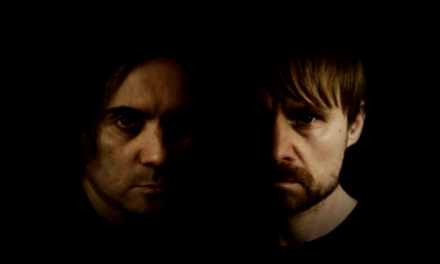
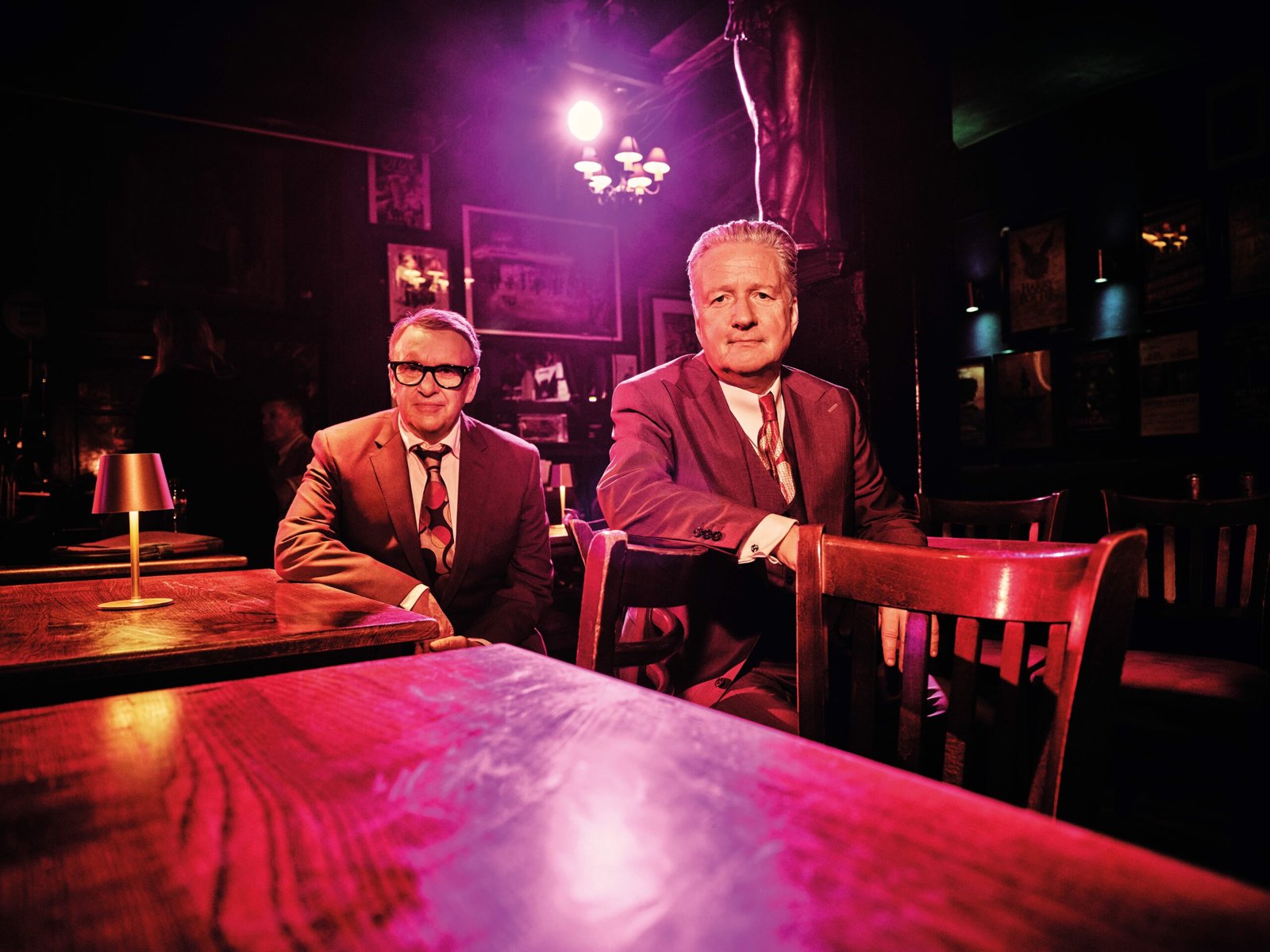
Feature Image Photo Credit: Dean Chalkley
Songwriting royalty Glenn Tilbrook and Chris Difford of Squeeze discussed their latest album ‘Trixies’ which is out now on BMG:
What is Trixies?
Chris: It’s an album that Glenn and I wrote in 1974, about an imaginary nightclub. We rehearsed it and then recorded some demos. In doing so, we discovered it was too complicated for us to play, so we shelved it and moved on.
Glenn: For the first couple of years that we were writing together, we hardly did any gigs. We were legendary amongst our friends though. That carried us along.
It’s hard to think of a precedent for this. You write an album when you’re still in your teens – but only get around to recording it 50 years later.
Chris: Well, it’s the most emotional journey I’ve been on for any records that we’ve ever made. As a band, we were leaning towards the basic sort of rock fodder that any band would try and write when they’re very young. This was three or four years before we even got to make our first record. Long story short, these were songs that we just didn’t have enough musical experience to record properly.
Glenn: Obviously, we brought all the knowledge that we have now to the table, but these are very much the same songs that we wrote then. The only difference is that I can teach the songs to the rest of the band. Back then, I didn’t even know what the names of the chords were.
What sort of a place is Trixies?
Chris: Before I met Glenn, I was reading Damon Runyon books, which had these funny, poignant short stories, typically set in the ’30s and ’40s in New York – and there was one about a nightclub and about the characters that inhabited it. So that inspired me to write a load of lyrics about what I imagined at a nightclub to be in those days, but actually, for me now, when I go back to it, it’s more like a nightclub in Soho in the ’60s.
Glenn: When I think about it, I imagine something like the Rainbow Room in Biba, but probably more down at heel than that. It’s the sort of place that was unobtainable to people like us, except in Chris’s imagination.
Chris: And I’ve been talking to some friends of mine who were villains in those days, and they’ve been filling me in on the skullduggery that was around, with people like the Krays turning up to pick up some drugs and all these clubs that used to open up at two o’clock in the morning. You’d have prostitutes. You’d have villains, drug addicts. You know, it would be a pretty seedy place, but it would have a band playing in the corner. And that would be the rhythm of the club. My other obsession at the time was musical theatre soundtracks. I recently met somebody from my council estate at one of my solo gigs, and he said, “All I remember about you is that you used to talk about writing a rock opera.” And I thought that’s really funny, because this is kind of what it has become.
When teenagers first start writing together, the results are usually not that great. It’s unbelievable that some of the first songs you wrote together were so good that here you are recording them 50 years later.
Chris: It’s extraordinary. But then, we had no distractions. We fully committed ourselves to songwriting. We went into Pathway Studios [in Islington, where Elvis Costello and Dire Straits made some of their earliest recordings] and recorded 24 demos, none of which would see the light of day. And they all sound amazing to me now. Those young guys were really on fire.
What about the instrumentation on those original demos? Was it just guitar and vocals?
Glenn: I was living with my girlfriend, Maxine at the time – and her house had a piano, so I did most of the writing on piano. And when we split up, I didn’t have a piano for a few years, so I didn’t do any piano songs after that. And the piano songs are often mostly more inventive than guitar ones, because in a funny way, you’re more creative on an instrument you don’t know as well.
When you’re young, it helps that you don’t know how much you don’t know. It means that you don’t doubt yourself. There’s no fear of failure.
Chris: I totally agree. And that’s what I’m drawn to with this record. I love the freedom of a young band making mistakes. I think it’s brilliant.
Glenn: Yeah, the charming naivety of the way we express ourselves is great.
There are tantalising glimpses of future directions in some of these songs. ‘Why Don’t You’, for instance, seems to share some of its DNA with ‘Take Me I’m Yours’.
Glenn: Yes, there’s that tango element going on – which is something I was obviously infatuated with for a while.
And then you’ve got ‘It’s Over’…
Glenn: Yeah, when I met Chris, I’d written maybe eight songs, while Chris had written significantly more songs, including that one. He was two or three years older than me, and fucking hell, ‘It’s Over’ was one of them. You know, how great is that?
What triggered the decision to revisit these songs?
Glenn: I think it was around 2023 that we found a decent version of the tape on which we recorded the original songs. We knew the 50th anniversary of the band was looming and it felt like a no-brainer. For all of that though, I think there would have been something a little bit soul-destroying about just working on something that was old. Which is why we’ve been working on an album of new songs at the same time. Those two projects sort of fed each other. I didn’t think Squeeze were going to do any more records until we started on Trixies. It has reminded me that you’ve really got to feel like you’re doing it for yourself – and if it comes to nothing, that’s ok.
Fifty years is obviously a long time. With everything you’ve learned about songwriting in the interim, was it tempting to change or add lines here and there?
Chris: I think we changed three lines in total.
It’s impossible to overstate the role that your bassist Owen Biddle (The Roots, John Legend, Al Green) played on the album. Was he always the natural choice when it came to finding a producer?
Glenn: As well as his complete musicality and experience, Owen had an outsider’s perspective – not just on Squeeze, but on this set of songs. And also, in terms of dealing with me and Chris, he was great there too. We could collaborate that way and just bounce off each other without getting down each other’s throats.
The sequencing of the songs on the original demo adhered to a narrative arc. But Owen has opted for a different sequence.
Chris: That’s right. But I’m happy with what Owen’s done. His passion – and Glenn’s passion – for making this record has been something that has just blown me away. The thought and intelligence that’s gone into the recording of these songs is truly exceptional.
The first that a lot of your fans knew about Trixies was on your last tour when you included ‘You Get The Feeling’ in your set.
Glenn: Yeah, the original version was more like an old blues song. It took me 50 years to figure out how to do it justice!
Trixies didn’t even get a passing mention in early Squeeze interviews. It seems like it was forgotten about very quickly.
Glenn: We just moved on to the next thing. Because we were writing constantly, you know? The only thing that made it onto an actual record was the chord sequence on the chorus of ‘The Place We Call Mars’ for the final track on [Squeeze’s 1998 album] Domino. Apart from that, we just moved on.
Beyond the album, could Trixies finally realise its destiny and be made into a musical?
Chris: It’s possible. We’d need to find the right scriptwriter. There are so many stories from that time, from the insalubrious pubs we used to frequent.
This project feels somewhat touched by destiny. It’s hard to write as freely as you did at that age, but now you have the musical ability to do justice to these songs.
Chris: Absolutely. And it would be really nice to be able to play it live as a stand-alone piece. I remember me and Glenn going to Wembley to see Elton John and he came out on stage and said, “I’m gonna do this new album I’ve just written called Captain Fantastic.” And of course, the whole audience just sat on the floor going, “What the f***? You know?” But it was the best thing ever. Because it held you in its spell.


Feature Image Photo Credit: Dean Chalkley
Band Photo: LtoR Stephen Large, Danica Dora, Simon Hanson, Glenn Tilbrook, Melvin Duffy, Owen Biddle, Chris Difford, Steve Smith
(credit Dean Chalkley)
Q&A Provided By and Published With Permission from Republic Media
Squeeze’s new album ‘Trixies’ is out now via BMG.
Purchase Here: https://squeeze.lnk.to/Trixies
Saturday July 4 2026 – Gwyl Portmeirion Festival, Wales (Only UK Show of The Summer)
Tried, Tested and Trixies Tour 2026 with Special Guest Billy Bragg. Dates – see www.squeezeofficial.com for ticket links
Thursday 12 November Glasgow OVO Hydro
Friday 13 November Blackpool Opera House
Saturday 14 November Nottingham Motorpoint Arena
Monday 16 November Newcastle O2 City Hall
Tuesday 17 November Stockton Globe
Thursday 19 November Hull Connexin Live
Friday 20 November Leeds First Direct Bank Arena
Saturday 21 November Liverpool M&S Bank Arena
Monday 23 November Manchester O2 Apollo
Thursday 26 November London The O2
Friday 27 November Cardiff Utilita Arena
Saturday 28 November Birmingham Utilita Arena
Monday 30 November Swansea Building Society Arena
Tuesday 1 December Plymouth Pavilions
Friday 4 December Bournemouth International Centre
Saturday 5 December Brighton Centre