Girlhood
Words by Glenn Sargeant
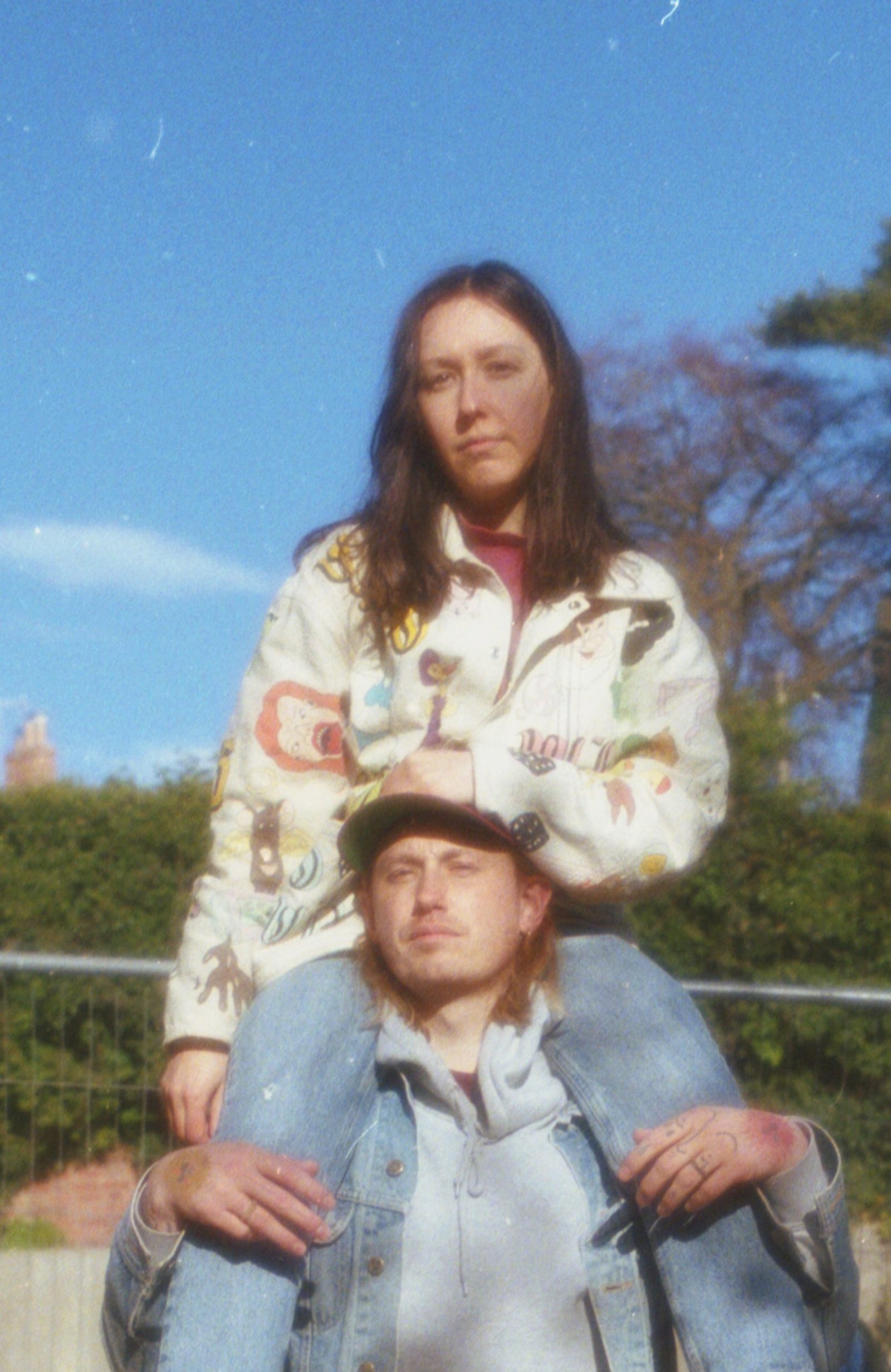
Feature Image Photo Credit: Supplied By Fifth Element PR
Critically acclaimed indie-pop band Girlhood have released the single ‘Lemon Aid’ ahead of Upcoming Album ‘This Will Make Sense In The End’.
Who is in Girlhood, how did you meet and what do you play?
Christian: Girlhood is me, Christian Pinchbeck, and Natalie Holmes. I produce the records, play most of the instruments and build the sonic world around the songs through samples, arrangement and whatever wonky production choices feel right. Natalie writes the lyrics and melodies, sings and plays acoustic guitar.
I first saw her supporting Jesca Hoop at a small venue in Stroud a couple of years ago. There was something incredibly honest about her writing and performance. The second she finished her set and started packing her guitar away, I walked straight up to the front of the stage and asked if she wanted to work together. Didn’t even give her a chance to get off the stage.
We quickly realised we were both people in our thirties trying to navigate a lot of the same mess that our generation seems to have been left with. That gave us plenty to connect over, both personally and in the writing, and we’ve become very close friends through making the album.
Natalie brings a grounding influence when my ideas threaten to disappear completely into chaos, but she’s equally willing to ride that chaos out with me and see where it leads. It’s the perfect balance. Neither of us makes the other’s work safer or more conventional, but we stop it from tipping too far in either direction.
What is your earliest musical memory?
Christian: Tinkering around on the piano at my grandparents’ house when I was probably six or seven. I was surrounded by very eclectic music as a kid and learnt piano, bassoon, clarinet and guitar. By the time I was a teenager, I was utterly obsessed.
Natalie: One of my earliest musical memories is playing piano in a themed school assembly for “Eternal Flame”. I was wearing Powerpuff Girls pyjamas, as the theme was “Dreaming”.
When did you begin songwriting?
Natalie: I must’ve been 15 or 16 when I started writing what I’d call songs and recording them on my computer. There were albums before my “first release”, and probably never-shared albums before those! There is, however, a video of me aged four or five making up a song about a magic carpet.
You will release your new album ‘This Will Make Sense In The End’ very soon. How did you want to approach the making of the album?
Christian: This album started as my f***-it button. I’d effectively quit Girlhood in my head and started making music again without the self-imposed strain of wondering what a Girlhood record was supposed to sound like. The instrumentals weren’t even intended to have vocals. I completely disregarded genre-baiting, which I’ve fallen into before, and just twatted about on Logic: cutting up instruments, limiting the number of tracks and doing almost the exact opposite of what I’d done on our previous album, Hot Mess.
Then I met Natalie. “Lemon Aid” had begun as a fully baked instrumental, but she picked up an acoustic guitar, followed its chords and we essentially rewrote the entire song from the ground up before piecing it back together. A lot of the album developed like that. Nothing was too precious to be pulled apart, and the original instrumentals gradually became something neither of us could have made alone.
It’s the clearest expression yet of what I always wanted Girlhood to be. I honestly don’t think it sounds like anything else out there.
Where did you record the album and who produced it?
Christian: Musically, it was mostly made at home on my laptop. We recorded some acoustic guitars and the main vocals at Natalie’s rented studio, although a few of the original SM57 live-take vocals survived into the final mixes.
I produced the album before passing it over to Barry Jamieson, who worked on it with me and helped bring the whole thing together. He also wrote and recorded orchestral sections and added some bass and beats.
Do you have any interesting, funny or memorable stories from the recording sessions?
Christian: The whole thing was a blast. I won’t forget our first writing session, making each other laugh by pretending to write toplines as Elton John or Britney Spears might write them. I’m fairly sure some of “Lemon Aid” emerged from that.
There was also our completely unplanned decision to fill the record with an obscene number of food metaphors. On “It Could Be Worse”, Natalie noticed I’d accidentally recorded the chorus in a different key from the rest of the song. Rather than fixing it, she built the vocal around it and somehow made it work. That probably sums up the record quite well.
Did you use any particular instruments, microphones or recording equipment to help you get a particular sound or tone for the record?
Christian: I’m a huge fan of distortion, unpolished takes and anything that sounds human. That’s the stuff that creates the little swell in my chest when I listen to music.
I was inspired by records like The Flaming Lips’ The Soft Bulletin and Animal Collective’s Strawberry Jam, as well as artists like Tupac, CocoRosie and Broken Social Scene. But the sound came more from manipulating what we’d recorded than from any particularly fancy equipment. We used what was available and tried not to polish the character out of it.
Which of your new album tracks hear you at your a) happiest, b) angriest and c) most reflective?
Natalie: Ha, well, lyrically, you might be able to guess. I felt all of those things during the time we were writing this album. “It Could Be Worse” is definitely the angriest, and “Cracked” the happiest.
“Born Hungry” was probably the most reflective, but for me every song is a deep dive into reflection city. I wrote “Born Hungry” towards the end of the process, so it was a reflection on: what just happened, why did I just write all of that, and what was the thread running through it?
Was it a difficult album to write?
Christian: Oddly, this was probably the most joyful Girlhood album to make, but it came after a very difficult relationship with the project.
The first version of Girlhood ended suddenly on the day our debut album was released. We’d sold out venues around the UK and done BBC interviews and sessions, then it was just over. I wasn’t well at the time. I was struggling with addiction, had become very controlling over the music and no longer recognised myself or my values. When the band collapsed, my drug use exploded with it.
I’ve spent much of the last four or five years rebuilding myself through rehab, NA, sponsorship and a lot of uncomfortable work. Girlhood remained this thing I couldn’t let go of. I didn’t really know what the project meant anymore, but it had carried me through too much darkness to abandon it.
This album changed that. Music has become the place where I can express emotions when my actual voice feels numb, and working with Natalie made Girlhood feel real again. As her stories emerged, the album developed an emotional journey I hadn’t anticipated. By the final few tracks, I’m usually in tears.
I fought to keep the songs in the order they were written because they trace someone struggling behind a smile until they finally burst, then gradually arrive somewhere personal and hopeful. It feels like Natalie’s story and mine meeting in the middle.
Who designed the album artwork?
Christian: The idea came to me as I was falling asleep. I asked a photographer friend to shoot it, and the very kind owner of our local Chinese takeaway let us use her shop.
We bought loads of food props to fill the shopping bags, but because we shot it on film, I didn’t realise until later that I’d ordered white bags rather than transparent ones. Most of the carefully selected props are basically hidden behind plastic. Great bit of art direction from me.
One of the tracks is the single ‘Lemon Aid’, which is out now. What was the story or inspiration behind the track?
Natalie: This was the first song we wrote together. We hadn’t really figured out a way of working yet, and I was with Christian in the studio trying to write lyrics in my notepad. I later decided it was far easier when I made him leave the room!
I must’ve just written the strongest things I felt in my body and gone from there, because those first two lines are what I always feel to some extent. I guess it has a simple meaning that everyone can relate to: that feeling of forlornness, when you don’t quite know what the point is anymore, but you also can’t bear to sulk and waste your life away, so you keep going in any way you know how.
Using music to boost my mood has always been a huge thing for me. I’d often turn to dancey pop or electronic songs to get those endorphins. The second verse dips into the relationship side of things that is expanded upon later in the album, and introduces one of the reasons I’m feeling so fed up. But again, I’m trying to find the silver linings and be grateful for my friends and all the good things in my life, so I can wake up and do another day.
Do you have any visualisers to accompany the album?
Christian: Yes. We love shooting them and making prats of ourselves. Neither of us takes social media, or the whole business of selling your personality as content, particularly seriously. It’s one big fucking joke to me. Go and listen to the music. Why are you watching me get waterboarded by lemonade?
Where is your hometown, and could you please describe it in five words?
Christian: Stroud, UK.
Wholesome. Liberal. Creative. Spiritual. Food-obsessed.
How do you look after your voices?
Natalie: I’ve had quite a journey with my voice and its relationship to stress in my body. The first time I was diagnosed with muscle tension dysphonia, it lasted for a year. I had to step away from music and socialising while I went through speech and language therapy.
That year taught me a lot, particularly about how much your mental health can affect your physical body. I’ve had a few shorter bouts since, always coinciding with the end of an album recording period or something else that created a feeling of release. It’s like when your body waits until you’ve done all the things before allowing itself to get ill.
The therapy and lessons I received for that condition taught me more than I could ever have learnt in regular singing lessons, and I feel extremely in tune with my voice now. Like anything, when it stays fine for a while, I get lazy and don’t look after it as much as I should. I’m feeling that stress on it right now after a lot of gigs.
To anyone experiencing tightness or pain in their voice: I hear you, and there are ways out of it. I couldn’t list everything I’ve learnt here, but the overall lesson is not to take your voice for granted. It is a muscle like any other in your body, and it can react to so many different things.
Do you have any live dates planned in the UK or Europe in 2026/2027?
Christian: We never really considered that this album might need to be played live, so figuring out how the hell we’re going to do that will be a test. We plan to, but that’s about all we can say right now.
What two things do you hope to have achieved once you have left the stage?
Christian: Connection and joy.
Do you have any favoured stage instruments, effects, pedals or microphones?
Christian: My 1976 Fender Strat, an SM57 and a 1930s Latvian acoustic guitar. Basically, anything that has reached the point of degrading where it becomes full of character.
Natalie: We had some disagreements here because I am in love with my Manley condenser microphone. It has a gorgeous, crystal-clear sound that suits my voice so well. Christian wanted me to record everything on the SM57 and I freaked! In the end, I convinced him.
Christian: I’m learning to let go more, but that was a tough one… hah!
You are given the opportunity to write the score for a film adaptation of a novel that you enjoy. Which novel is it and why?
Christian: The Giraffe and the Pelly and Me by Roald Dahl. It holds a very dear place in my heart, and I now read it to my eldest son. The song at the end, about friendship between a group of freaks who have found one another, completely breaks me every time. Some deep childhood PTSD shit going on there, clearly. I’d love to write something that captured all of its oddness, warmth and melancholy.
Natalie: That’s so weird. Completely coincidentally, that is the one children’s book I own! I found it at a second-hand sale not long ago, remembered how much I loved it and picked that one. Freaks unite!
Who are some of your musical influences? Do you have any recommendations?
Christian: I’ve mentioned a few of my production influences already, but at the moment I’m listening to Cameron Winter, Wes Parker, Peter Cat Recording Co., Mildred, Band of Horses, J Hus and Racing Mount Pleasant. Consider all of those recommendations.
Natalie: My biggest inspirations as a singer and songwriter have to be Aurora, Caroline Polachek, The Japanese House, Sara Bareilles and Bon Iver. I love unique voices, strong melodies, interesting production and being moved deeply.
What makes Girlhood happy, and what makes you unhappy?
Christian: Seeing people overcome themselves and genuinely connect makes me happy.
Feeling disconnected from myself, or watching somebody else become trapped inside themselves, makes me unhappy. I’ve spent enough time there to recognise it.
Natalie: Being in nature and cooking makes me happy. Cooking will always be my way of relaxing and switching off. Oh, and dancing! Maybe just listen to the songs and you’ll find out everything about me. I also love knowing that I’ve connected with people who are listening to songs I’ve written, and I love a deep conversation.
My health often makes me unhappy. Not being able to predict from one day to the next how I’m going to feel in my brain and body is difficult. I’m extremely sensitive to life, which makes me a born songwriter, but not all that hardy! However, I think being a DIY musician changes your bar for “hardiness” quite drastically, and I’m probably doing pretty alright.